
What SynkRoot Does: Software, Products & Digital Solutions
Explore what SynkRoot does, from custom software and digital products to business applications, automation, and connected technology solutions.
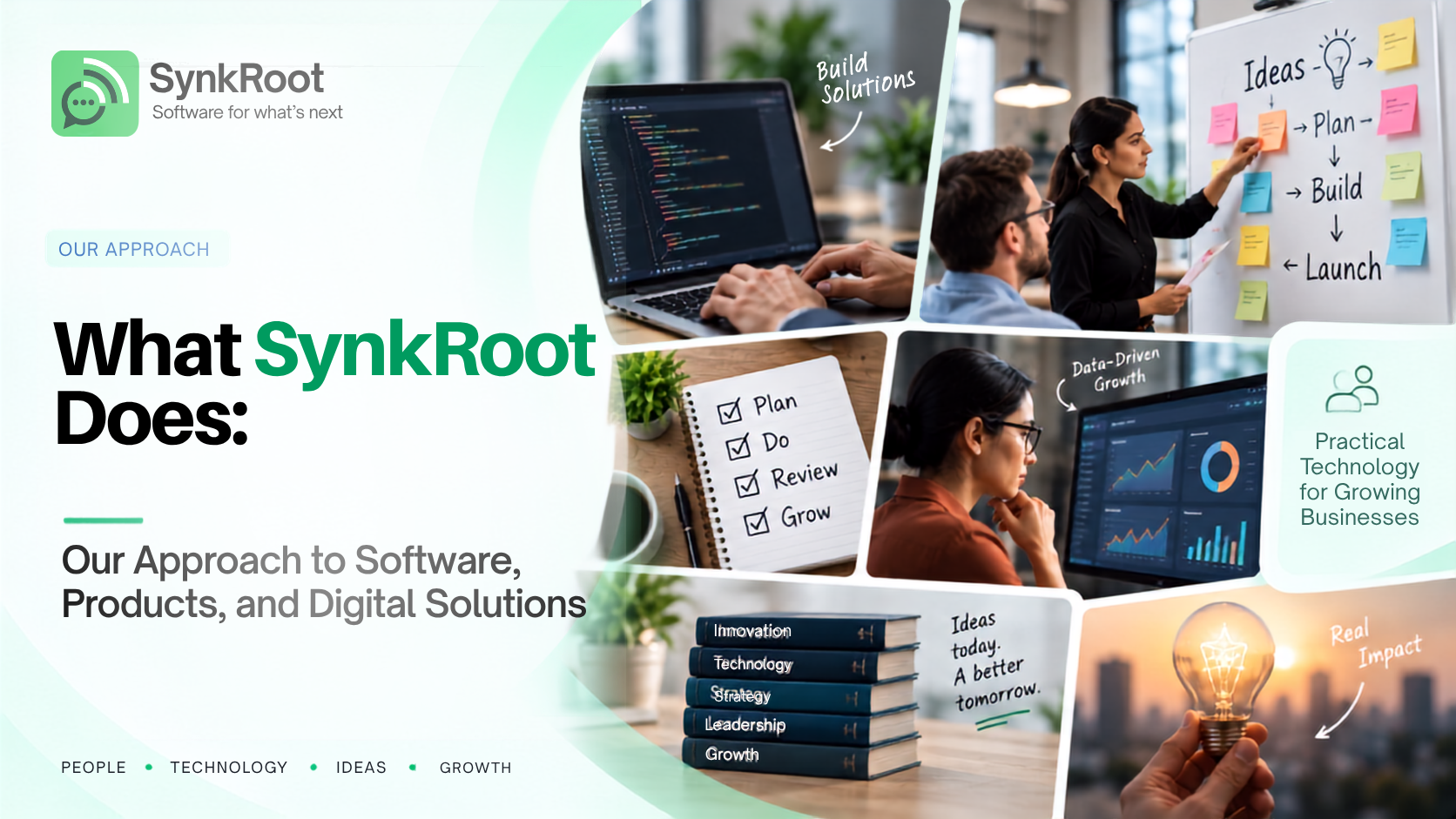
What SynkRoot Does: Our Approach to Software, Products, and Digital Solutions
When a business decides to invest in technology, the first question is often:
What should we build?
But an equally important question is:
What problem are we trying to solve?
At SynkRoot, we believe the best technology decisions begin with understanding the business need.
A company may need a new software product, a better internal workflow, a mobile application, or a way to connect existing systems. Each requirement is different, and each deserves an approach that fits.
Here is an overview of the kind of technology work SynkRoot focuses on.
Custom Software Development
Not every business can find an existing software tool that fits its needs.
Sometimes the workflow is unique. Sometimes the business needs a specific feature. Sometimes the available tools are too restrictive or do not work well together.
Custom software development can help businesses create solutions around their own requirements.
This may include:
Business management applications.
Internal tools and dashboards.
Customer-facing web applications.
Industry-specific software.
Systems that connect different business processes.
The goal is to build software that supports the way the business actually works.
Digital Product Development
A product idea is only the beginning.
Turning that idea into a working digital product involves understanding users, defining requirements, designing experiences, building software, testing, and improving the product over time.
SynkRoot's product-focused approach is intended to help businesses and teams move from an idea toward a usable digital product.
This can be relevant for startups, businesses launching new services, and teams looking to improve an existing product.
The important part is to start with a clear understanding of the user and the outcome.
Web Applications
A website and a web application are not always the same thing.
A website may primarily provide information. A web application allows users to perform actions, manage information, or complete tasks through an interactive system.
Examples include:
Customer portals.
Business dashboards.
Booking systems.
Workflow applications.
Online management platforms.
A well-designed web application can bring together the user experience, business logic, and information needed to complete a task.
Mobile Products
Mobile devices are an important part of how people interact with businesses and digital services.
Depending on the use case, a mobile application may help customers access services, allow teams to work remotely, or provide a more convenient way to use a product.
Mobile product development involves more than adapting a website to a smaller screen.
It requires consideration of mobile user experience, performance, navigation, device capabilities, and the needs of the people using the application.
Business Applications and Operations
Many businesses struggle with processes that have grown over time.
Approvals may happen through messages. Tasks may be tracked in spreadsheets. Important records may be spread across different tools.
A business application can help bring these activities into a clearer and more connected workflow.
SynkRoot's operations-focused solutions are designed around ideas such as:
Connected workflows.
Clear ownership.
Approval and task routing.
Centralized records.
Better visibility into work.
The right solution depends on the process and the people involved.
Automation and Integrations
Automation is often discussed as a way to save time, but its value goes beyond that.
A well-designed automated workflow can help reduce repetitive work, improve consistency, and make it easier for teams to focus on important tasks.
Integrations can also help systems work together.
For example, a business may need customer information to move between its sales system and another application. An integration can help reduce duplicate data entry and make information more connected.
The key is to automate and integrate where it makes practical sense.
How We Approach a Project
Technology projects are easier to manage when the path is clear.
A typical project may involve:
Understanding the business and its requirements.
Defining the problem and desired outcome.
Planning the solution.
Designing the user experience.
Building and testing the software.
Launching and improving the solution.
Not every project follows the same process or timeline. The scope, complexity, and goals will determine the right approach.
Choosing the Right Starting Point
If you are considering a technology project, it helps to begin with a few questions:
What problem are we trying to solve?
Who will use the solution?
What does success look like?
What needs to be included in the first version?
What should the system be able to do in the future?
These questions can help turn a broad idea into a more practical plan.
Technology That Fits the Business
At SynkRoot, our focus is on building useful technology around real business needs.
Whether the requirement is custom software, a digital product, a business application, automation, or a connected system, the first step is understanding the problem.
From there, the right solution can take shape.
Explore SynkRoot's solutions to learn more about how we approach software, products, and business technology.
Thanks for reading.
DISCUSSION
Comments (0)
No comments yet. Be the first to share your thoughts.